

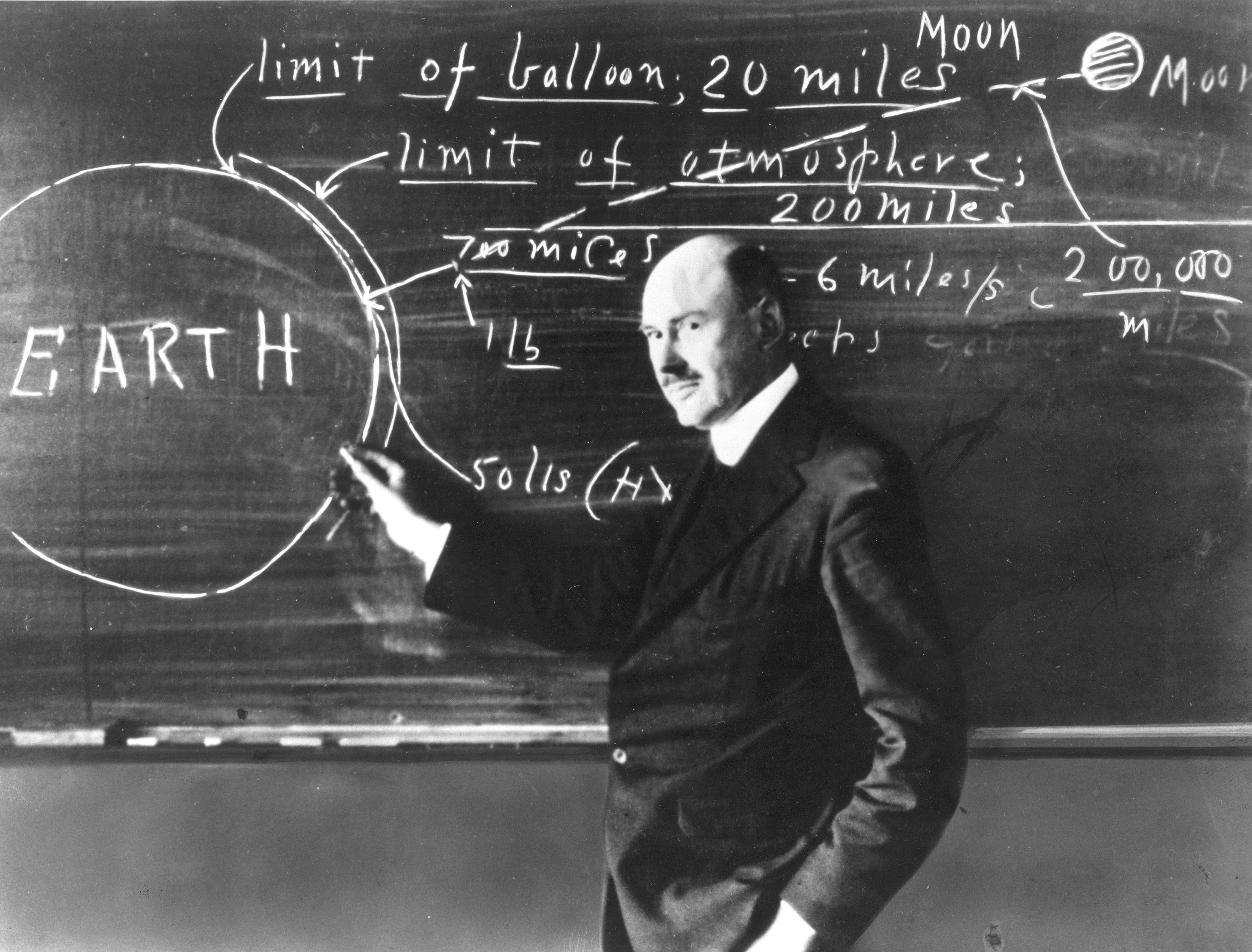
*Dr. Robert H. Goddard at a blackboard at Clark University in Worcester, Massachusetts, in 1924. *This image file is in the public domain in the United States because it was solely created by NASA. NASA copyright policy states that “NASA material is not protected by copyright unless noted“.
Happy St. Patrick’s Day.
Today, March 17, is St. Patrick’s Day. But do we know the importance of yesterday, March 16?
March 16 is Goddard Day—and 2026 marks the centennial (100th anniversary) of one of the foundational events in the history of space travel.
That contrast is worth pausing over. Not because there is anything wrong with St. Patrick’s Day, but because the imbalance reveals something about culture itself.
St. Patrick’s Day began as a religious feast day and, in the United States, evolved into a broad secular celebration of Irish culture, parades, symbols, and festivity. Goddard Day, by contrast, was formally designated by Congress in 1965 to honor Robert H. Goddard’s scientific achievement on the anniversary of his breakthrough in modern rocketry.
A civilization needs festivals. It needs memory, ritual, music, color, and other forms of celebration.
But it also needs to honor the minds that expand human power.
That is why March 16 deserves more notice than it gets.
It marks the anniversary of Robert H. Goddard’s first successful flight of a liquid-fueled rocket in Auburn, Massachusetts, on March 16, 1926. By later standards, the flight was tiny: it lasted only 2.5 seconds, rose about 41 feet, and traveled about 184 feet. Yet historically, it was enormous.
It was one of the founding moments of modern rocketry.
More Than “Inventing Rockets”
Goddard’s importance is often described too vaguely.
He was not important because he “invented rockets.” Rockets had existed for centuries in more primitive form. His importance was that he helped move rocketry onto a serious engineering path.
He was the first to develop a rocket motor using liquid fuels—liquid oxygen and gasoline—an approach that later became central to modern rocketry.
Goddard’s first flight was tiny in scale but large in consequence. To a casual observer, it would not have looked like the future. But it proved that liquid-fueled rocketry was not fantasy, and that proof helped open the engineering road that later led to missiles, launch vehicles, satellites, and the space age.
That is why Goddard’s importance is not simply that he used liquid fuel. His deeper importance is that he helped move rocketry from pyrotechnics to engineering. The liquid-propellant flight marked that shift.
That is not a minor technical distinction. It marks the difference between something that merely shoots upward and something that can become a machine.
A firework goes up. A real rocket has to do much more.
It has to generate enough thrust to overcome its own weight. It has to burn propellant efficiently enough to gain meaningful speed. It has to remain stable in flight. It has to become steerable. It has to scale into something larger and more capable.
That is the threshold Goddard helped cross.
His achievement was not merely that he launched something successfully. It was that he helped establish a path toward the kind of propulsion that could become more powerful, more controllable, and more scalable than older solid-fuel rockets.
His work also went beyond fuel itself. He worked on guidance, control, staging concepts, and the underlying physics that made modern rocketry possible.
That is why Goddard belongs near the beginning of the modern rocket age.
Not because he did everything that came later, but because he helped make those later developments technically possible.
Why “Technically Possible” Matters
That phrase matters.
Cultures tend to remember the spectacular culmination and ignore the earlier breakthrough that made it possible.
People remember the Moon landing, the giant launch vehicle, the missile, the dramatic public achievement. Far fewer think about the earlier experimental work that made such things conceivable in the first place.
But causality runs upstream, not downstream.
Goddard’s liquid-propellant work did not leap directly from a Massachusetts farm field to Apollo. What it did do was more foundational: it helped establish the engineering foundations of modern rocketry.
Later engineers and programs would scale those foundations, integrate them into larger systems, weaponize them, industrialize them, and eventually use them for exploration. But that path had to be opened first—and Goddard helped open it.
Why Goddard Was Ridiculed
There is a reason the ridicule he endured is so revealing.
In 1919, Goddard published A Method of Reaching Extreme Altitudes (the link may load slowly, but it does load), a serious scientific treatise. Public attention fixed on its most dramatic implication: that rockets might someday reach space, even the Moon, and much of the press treated the idea as absurd.
Why was he mocked?
Partly because he was ahead of the public imagination.
But partly because many of his critics did not understand the science.
A rocket does not need air to push against. It works by expelling mass at high speed. That is precisely why rockets are suited to operation in space.
So the criticism of Goddard was not merely dismissive. It was technically ignorant.
That is a broader cultural pattern. Public ridicule is often most confident where understanding is weakest.
The establishment mocks first. Reality answers later.
And later is often too late for proper credit.
Recognition Came Late
Goddard died in 1945.
Only later did the country move formally to honor what he had done.
Congress designated March 16, 1965, as Goddard Day, and President Lyndon B. Johnson issued a proclamation calling on Americans to observe it. The proclamation stated that Goddard:
“established a foundation for the development of modern rocketry and made possible the exploration of space.”
He established a foundation. That is the right level of credit.
He should not be treated as if he did everything that followed. He did not.
Subsequent advances in rocketry involved larger systems, better control, improved manufacturing, military development, and eventually the conversion of missile-era capabilities into orbital and lunar launch systems.
Those are later chapters.
Goddard’s place is earlier and more foundational.
The Cultural Point
And that returns us to the larger cultural point.
Almost everyone knows St. Patrick’s Day.
Almost no one knows Goddard Day.
Again, the point is not to diminish festivity. It is to notice what we celebrate more readily—and what we too easily forget, or never learn in the first place.
We are quick to remember what is visible, social, symbolic, and emotionally easy. We are much slower to remember what is technical, abstract, causal, and upstream.
St. Patrick’s Day asks almost nothing from us beyond participation.
Goddard Day asks for something quieter and more demanding: admiration for disciplined intelligence, engineering persistence, and the kind of breakthrough whose significance is not obvious unless one thinks in terms of causes.
We know the parade more readily than the propulsion breakthrough.
That is not merely a curiosity. It says something about how cultures drift away from first causes. They celebrate the visible effect and neglect the invisible generator. They enjoy the benefits created by civilization while forgetting the kind of minds that built its power.
Why Goddard Still Matters
Robert Goddard matters for that reason.
He was not the final public face of the space age, and he was not the man most people associate with the great rockets of the mid-twentieth century. His place in the story is earlier than that, and in some ways more fundamental. He helped convert aspiration into engineering reality.
That is why Goddard Day deserves more than obscurity.
Not because commemorative days are inherently important, but because what we choose to remember reveals what we truly honor.
A culture serious about the future should know how to celebrate not only festivity, but also causality. Not only heritage, but invention. Not only identity, but achievement.
Yes, enjoy St. Patrick’s Day.
But as you do, it is worth reflecting on March 16 and asking whether we know the name of the man whose work helped put humanity on the road to space.
A civilization that remembers the feast day and forgets a foundational step in becoming spacefaring is a civilization that is losing sight of first causes.
Robert Goddard deserves better than that.
So does any culture that hopes to have a future worth building.
This St. Patrick’s Day, take a moment to remember the day before—Goddard Day—not just this year, but in the years to come.
Follow on Linkedin: https://www.linkedin.com/in/chakkakani/
This article is a great reminder of Robert Goddard’s foundational contribution to modern rocketry. The history of rocketry is truly fascinating, from Tsiolkovsky’s rocket equation establishing the theoretical basis of spaceflight in 1903, to Goddard proving it through the first liquid-fueled rocket, followed by the V-2 engine (von Braun) era that indirectly accelerated the space race. From Sputnik to Apollo, the International Space Station to today’s commercial spaceflight era with Falcon 9 reusability, Crew Dragon, Chandrayaan missions, Mars rovers, and Starship, each milestone builds on the work of earlier pioneers.
It is important to celebrate and remember people like Goddard. Visionaries like Musk and others are clearly standing on the shoulders of giants like Tsiolkovsky, Goddard, and von Braun as humanity takes its next steps toward becoming an interplanetary species. We are fortunate to be living in a time where we can witness this new chapter of space exploration unfold.
Thank you for writing this thoughtful piece. It inspired me to revisit the remarkable history of rocketry.